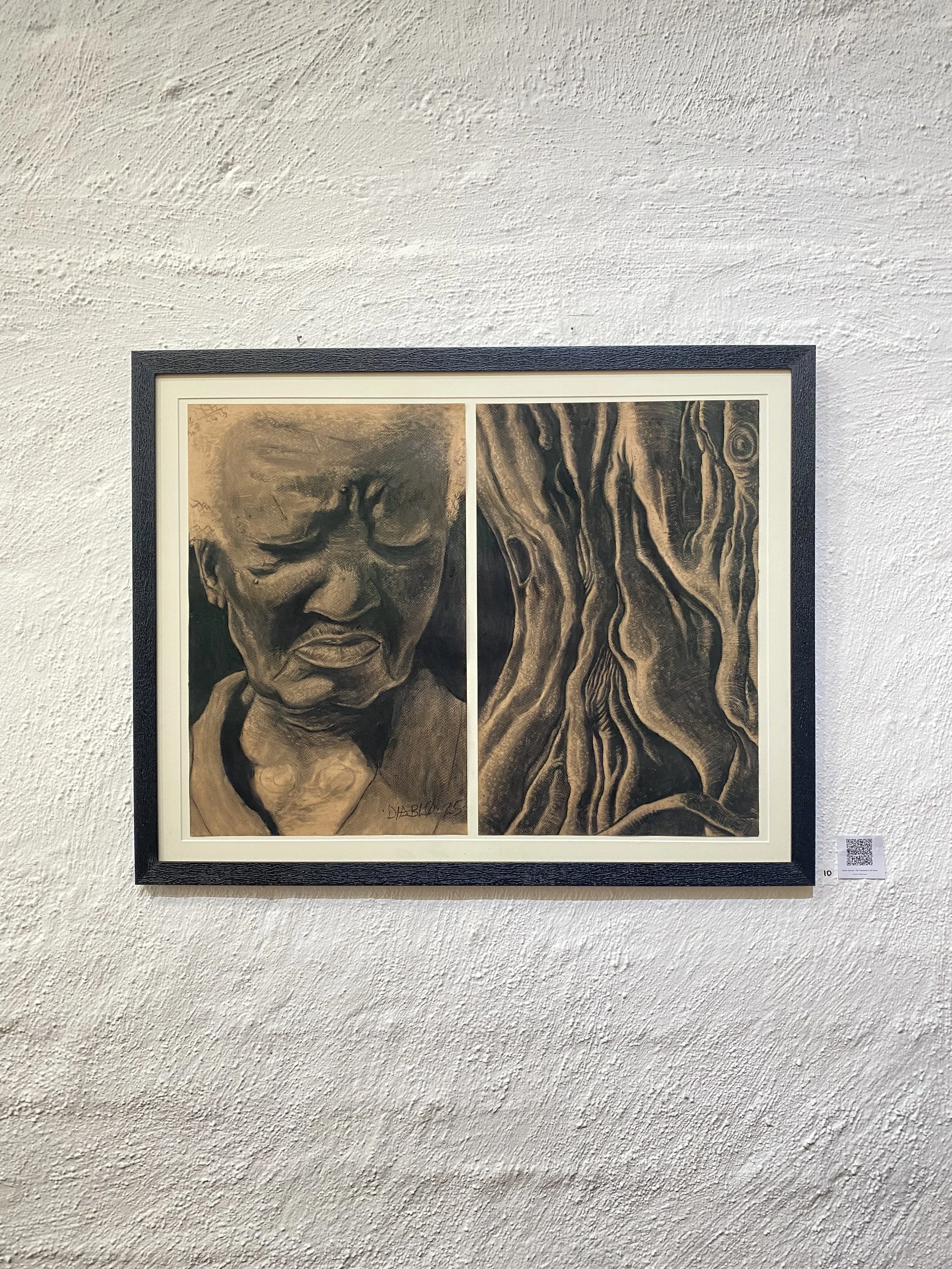
Mother Mowana – My Grandmother, MyHome
This essay grows out of a recent making process I’ve been part of - something between a challenge, a workshop, and a residency - built around a documentary following six artists as we attempt twelve works together and alone. Working with collaborators made the theme of home feel almost gentle, something we could approach side-by-side without having to dig too deep. But the moment I had to face the theme on my own, it shifted. It asked for something more personal, something I’ve avoided for years.
So this piece sits in that space - the quiet, slightly uncomfortable place where exploration becomes confrontation. It is a reflection on family, on memory, and on the person who reflects me most profoundly: my grandmother.
This theme of home has seen me explore the notion of home with two collaborators - which has been, or was, somehow despite my odd social disposition, far easier than exploring the concept on my own. I feel like with my collaborators I have explored the concept, as opposed to what the theme or concept demands of me on a personal level: confrontation. On my own, the concept of home has been something I must confront rather than merely explore. There’s no common ground to search for, so I have to address it on a deeply personal level - a confrontational notion I have always avoided, even hidden from.
I have lived in multiple places in my life: different neighborhoods, different towns, different houses. But one thing that has made all of these places feel like home - the one thing that has remained constant, for better or worse - was and continues to be the people: my family. The people who have protected me, guarded me from the harshest realities of life - from themselves, from myself - even to my own detriment, but always with what I’d like to believe were their best intentions at heart.
My biggest fear in life - one that lives among many others in my fearful, anxious psyche - is, and has always been, losing my loved ones. Losing my family. Very early on, my great-grandmothers, women I met in the very final stanzas of their respective existences, confronted me with the bitter reality of their impending mortality - something that for me would come to pass sooner rather than later. They rightfully thought I did not understand them, which I didn’t. However, what they might not have anticipated was the fact that I would remember - and eventually, once I understood the permanence and irreversibility of death, I would understand what they meant - and have it burned deep into my psychology, stored on the top shelf of the sources of my many anxieties.
I was not really close to them, but I loved them dearly because I could see and feel how much they meant to the rest of my family - the people who had time with them. Theirs were the first funerals I ever attended. My mind was in the very early stages of its formation, and I didn’t quite understand the oh-so-depressing commotion of a funeral. I was a bright child, but I was as stupid as anyone who was guarded from reality would inevitably be. I did not understand, but time and life would partner up to ensure that I eventually did.
In adulthood, my art first manifested through the oh-so-confrontational medium of photography. I avoided pointing my camera inward toward myself and my family for years, focusing my lens on fashion models instead. My grandmother - the strong and sturdy Mowana tree that raised all of us in our earliest years - would often tell me that she wanted me to capture photographs of her for her funeral program, bringing to the surface a notion I never wanted to face but always knew I couldn’t avoid forever: her mortality. This April, she turned ninety years old - only eight years younger than her mother was when she left us forever, and thirteen years younger than my father’s grandmother was when she passed on to rejoin our kin gone from this world.
I have never captured images of my family with any real intention of immortalizing their image. And since I’ve distanced myself from photography to embrace drawing and painting, I have actively avoided capturing their image or emotional essence in those mediums too - especially my grandmother.
My grandmother is undoubtedly the best traceable source of myself - the member of my family I am most similar to by a long way. The source of my best bits: my loving nature, my talent, my work ethic, and, dare I say, my good looks. She is also the source of my most difficult attributes, as well as being partially responsible for exposing me to my earliest traumas. She is the source of my anxiety disorder, my bad temper - a burning rage few can relate to - my attention disorder, and my pride. Some of these traits I inherited from my parents, of course, but they have always presented themselves as clearly in my grandmother as they do in me. Clear as coal pressed into crystal. Clear as diamond.
She unknowingly exposed me to the brutality of Christianity early on. She did not allow me to be eased into the religion through Sunday school because she never wanted to let me out of her sight - even in church. She exposed me to the brutal, unkind nature of love through her turbulent relationship with her son, my uncle Santana, whom she could never part with or stop protecting despite his abuse of her and her goodwill - a reality that forced my parents to stop taking me to hers for weekends, denying me regular access to her. She also cut down my favorite fig tree, whose fruits were one of the highlights of visiting her when I was young - something we often laugh about together nowadays.
Like my grandmother, I have never been able to hide how I am feeling - joy and despair alike. Our hearts worn on the outside of our sleeves, for better or worse. Always exposed. Always susceptible. To me, she is the truest reflection of myself - one I know I will not always have. Of all her grandchildren and great-grandchildren, I am the one who has enjoyed her the least. I spent the least time with her as a child, and I have been the wariest of her in adulthood - a fact that I am partially to blame for, and one I regret deeply.
Our proud Mowana, Mmapula Pule, has always been strong, steady, and stubborn - almost always refusing to leave her precious home and grandchildren to visit us. How time weakens even the strongest and sturdiest trees. A few months ago, her roots loosened, her sturdy stem shaken, her pride swallowed, as she was forced to move in with us due to her declining health - uprooted from her precious garden and, maybe temporarily, planted in the nurturing soils of her daughter’s. A move she has taken to with an oddly uncharacteristic grace.
I’ve since had the pleasure and privilege of full, unfettered access to her, though the experience has been marred by numerous health scares and, again, exposure to the unfiltered rawness of her misery - which, as I mentioned, she has never been able, nor attempted, to hide. Her pain and fragility were exposed to me in full recently when I had to pull her from her bed in the middle of the night after being awoken by her loud shrieking calls to me. As I carried her to the car, I felt the unavoidable truth of what time has done to her and to my family and to me. It has made my steady mother Mowana frail - light in weight and easy to carry. It has also reversed our roles in each other’s lives. That night I carried her and cared for her and protected her with a similar ferocity to what she once had for me when I was smaller and more fragile than her. Oh, how time changes things. Oh, how time changes things.
In my first collaboration, we explored the notion of home through the nostalgic yet contemplative lens of memory, depicted through a hardened teddy bear made with materials that reference the home as a physical structure. My second collaboration has seen me explore the notion of home through the interrogation of nationhood and belonging, with photographs that immersed my collaborator and me in the natural elements of the city we have lived in for most of our lives.
My third interrogation of the theme of home has forced me inward - to a more private reflection on one of the people who has represented home to me, and on the confrontational reflection of self and family. This final piece is yet another diptych which features 2 detailed charcoal drawings – one, a portrait of my Grandmother and the other, a textured re-imagination of the thick layered stem and exposed roots of a Mowana tree (Commonly known as the Baobab tree) - made on beige paper, mounted onto an off-white board and housed within a single wooden-textured frame. This juxtaposition of an aged matriarch and the Mowana tree is echoed throughout this essay, which is meant to be read alongside the visual artwork.